Now we infer the inequation under which the system is deadlock-free.
What Changed
The spec and config are extended to systematically check when the deadlock invariant holds and when it does not.
Key Insight
The relationship stated in the upstream tutorial is that the original single-wait-set algorithm is deadlock-free if and only if:
2 * BufCapacity >= Cardinality(Producers \cup Consumers)
For example, two producers and two consumers need capacity at least two. In this lesson's multi-configuration model, apply the relationship to the chosen variables bufCapacity, producers, and consumers, not just to their upper-bound constants.
We infer this relationship from finite data points. Model checking these bounds is not, by itself, a mathematical proof for all process counts and capacities.
Collecting the Data Locally
Save this lesson's spec and configuration as BlockingQueue.tla/.cfg alongside tla2tools.jar, then use the upstream workflow:
java -jar tla2tools.jar -workers 1 -deadlock -continue BlockingQueue | grep InvVio | sort | uniq-continue keeps exploring after invariant violations. -deadlock disables the separate built-in deadlock check; our invariant still identifies the all-waiting states. Each InvVio record contains the chosen capacity and total thread count.
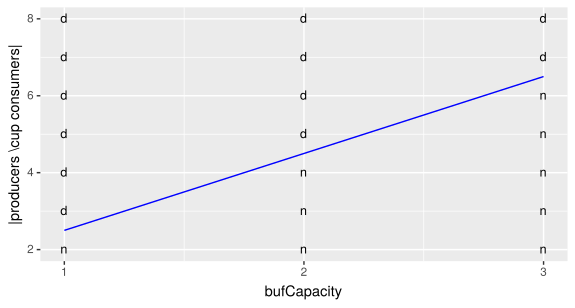
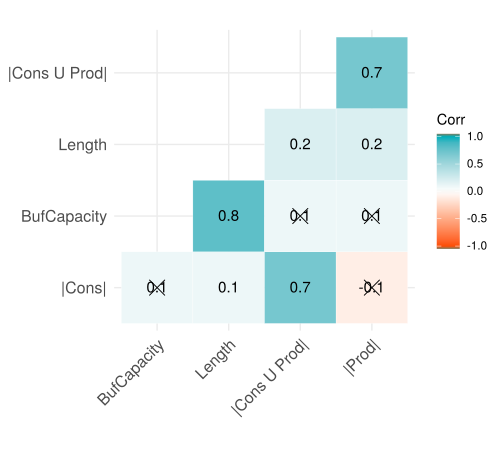
Collecting even more data, we can correlate the length of the error trace with the constants:
Expected Result
The browser reports the first Invariant violation and prints an InvVio record. It does not expose -continue, so it will not collect all the data shown in the upstream plots. Try the local command to collect all violating configurations within the supplied bounds.